Delivered to 15,000 Plainfield "doorsteps" Monday, Wednesday, Friday & Sunday

Showing posts with label Housing. Show all posts

Wednesday, June 22, 2011

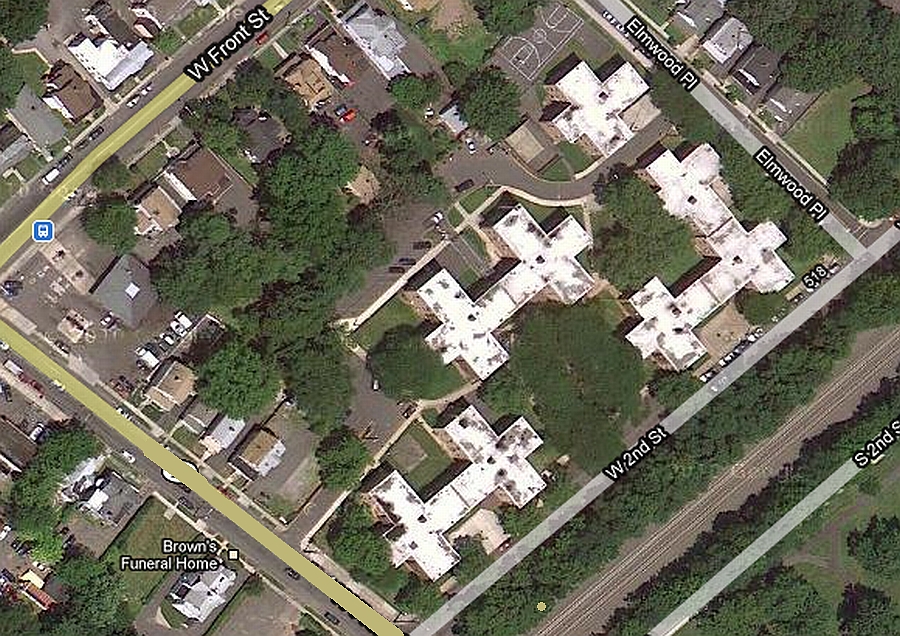
Elmwood Gardens proposal clears another hurdle


Proposal to replace complex with townhomes moves to next step.
 
The Housing Authority of Plainfield's proposal to replace the aging, crime-ridden and non-compliant Elmwood Gardens complex on West Second Street with 72 townhome units cleared another hurdle Monday when the City Council passed a resolution authorizing the Planning Board to conduct a study as whether the area was 'in need of redevelopment' (see previous coverage here).

Immediately after the resolution had been introduced and seconded, Councilor Bridget Rivers moved to table the item. Without a second to the motion, Council President Annie McWilliams invited HAP Executive Director Randy Wood to the mike to take questions from Council members.

The Housing Authority owns and manages Elmwood Gardens along with other complexes in the city, as well as some privately-owned HAP-managed properties. While HUD has management guidelines and ultimate oversight of local housing authorities, the properties are managed by the local housing authority and not HUD directly.

Wood addressed the question of how existing tenants would be treated in the changeover, insisting that ALL RESIDENTS IN COMPLIANCE would be eligible for the relocation program and would be issued Section 8 vouchers which he reiterated can be used anywhere in the country, including Plainfield
(for more about the vouchers and how they work, see here and here).

In a story in this past Sunday's New York Times (see here), Water's Edge, an 81-townhome development in Elizabethport which replaced two notoriuously derelict and crime-ridden complexes gets high marks from resident Wynona Ancrum, who is also chair of the Elizabeth Housing Authority's board --
“I don't think you need homeowners to have a strong community,” said Wynona Ancrum, who has lived in public housing, as a renter, for most of her life.

“The way your neighborhood is designed and put together, that’s what is important,” said Ms. Ancrum, 55, who heads the board of the Elizabeth Housing Authority. “Not whether you own, or you are a renter.”
Councilor Mapp had several pointed questions about whether a PILOT (payment in lieu of taxes) would be proposed and whether the income associated with Section 8 vouchers would be included as 'revenues' in HAP's PILOT calculations.

Wood answered that there a PILOT would be requested (PILOTS are mandated by the state if it puts up the money for the project, and the fees paid to a municipality are set within formulas established by the state in setting up the PILOT). Though he was not prepared to discuss the PILOT matter further at this time, Wood assured the Council that the matter would be thoroughly presented to it when the time came.

After Councilor Rivers was reassured by Wood that further informational meetings with the tenants would be held (Wood reported on one that took place already and included other residents from the neighborhood), and by fellow Council members that the Planning Board's recommendation would have to be voted on by the Council (meaning further opportunity for deliberation), Rivers withdrew her motion to table.

The resolution then passed unanimously.

The matter now goes to the Planning Board, where expeditious action is expected.


View today's CLIPS here. Not getting your own CLIPS email daily? Click here to subscribe.

Thursday, June 16, 2011

Housing Authority exec outlines plans for Elmwood Gardens


The four Elmwood Gardens units, plus unspecified other properties
would be included in a redevelopment plan.
The Housing Authority of Plainfield's executive director, Randy Wood, appeared before the City Council Tuesday evening to request it instruct the Planning Board to do a study to declare the Elmwood Gardens complex and its 'surrounding neighborhood' in need of redevelopment. (This is the first I can recall hearing that the area would include properties in addition to the HAP buildings themselves.)

The designation of a redevelopment area will then allow the process of replacing the current four-building multi-story configuration of 128 apartment units with 72 townhome units.

Wood listed the reasons for the requested redevelopment area designation --

Higher rate of crime activity than elsewhere in the City, due to...
  • Antiquated interior design;
  • Unsecured unit access;
  • Shared common hallways;
  • Lack of defensible interior space;
...all leaving residents feeling intimidated by loiterers, drug dealing and vandalism.

Additionally, none of the buildings is ADA-compliant, which negatively impacts the quality of life of residents.
In his opinion, the redesign into townhomes will reduce criminal activities significantly and will revitalize the surrounding neighborhood.

Wood noted that residents have already been informed of the Housing Authority's long-range planning, and that putting a redevelopment plan in place by August would allow for the Authority to begin relocation of remaining residents in October.

It was stressed that no QUALIFIED residents will be left homeless; they will receive Section 8 vouchers that are usable countrywide for relocation purposes.

There are currently 13 vacant units, with one quarter of residents out of compliance with HUD regulations. Fourteen units are in eviction litigation, with a further twelve units where non-payment of rent is at issue. Wood estimated that 70 of the 128 units would be vacant by October.

A redevelopment plan would include a zoning change from R-4 to R-7, and the proposed townhomes would be built by a private developer with financing by the NJ Mortgage and Finance Agency.

Financing through NJMFA carries with it tax credits for the developer and mandatory provisions by the state that the municipality execute a PILOT (payment in lieu of taxes) agreement with the developer.

To my mind, this is actually preferable to the current situation, in which the Housing Authority properties are tax-exempt. Wood stated that the project would add approximately $14 million to the assessment rolls. A PILOT payment would certainly go a long way to relieving the burden on the taxpayers, who have been picking up the policing costs associated with Elmwood Gardens since its inception.

Councilor Rivers, participating by phone, was critical of plan, expressing concerns over whether some residents might be left homeless. Wood had complete control of his facts, and reaffirmed that
no QUALIFIED residents will be left homeless.

Having a study by the Planning Board done, passed by the Board, referred to the Council for agenda-setting and passed by the Council at its August business meeting will require good coordination.

Let's hope everything moves like clockwork.


-- Dan Damon [follow]

View today's CLIPS here. Not getting your own CLIPS email daily? Click here to subscribe.

Tuesday, January 25, 2011

Assemblyman Green, Gov. Christie on affordable housing merry-go-round?


Plainfield Assemblyman Jerry Green just ain't gettin' nothin' but disrespect from Gov. Chris Christie, who yesterday conditionally vetoed the affordable housing bill over which the Assemblyman has labored so mightily since last Spring.

In his veto memo, Christie said --
If the goal of this legislation is to replace an already broken system for providing affordable housing with a common sense, predictable and achievable process, then this bill sorely misses the mark...
Each of the three news reports cited below gives a good summary of the legislation's progress so far, though I think the NJ Newsroom version is ahead by a nose.

Will the legislation, which I think will be seen as Jerry's enduring legislative legacy after a long career in the Assembly, ever get signed? Sen. Lesniak thinks so.

Maybe.

But as far as Jerry and 'respect' go, I cannot help but notice that every time the bill is in trouble or being dumped on, it is Jerry's bill, and when folks are lining up for the celebratory photo opportunity, it is Sen. Lesniak's bill.

What kind of 'respect' is that?


-- Dan Damon [follow]

View today's CLIPS here. Not getting your own CLIPS email daily? Click here to subscribe.

Thursday, January 13, 2011

Will Christie sign housing bill, sealing Jerry's legacy?


Plainfield Assemblyman Jerry Green.
Will housing bill become capstone of longtime legislator's career?

Will Gov. Chris Christie sign Plainfield Assemblyman Jerry Green's career-capping affordable housing legislation (S1/A3447, see here)?

That is the only question remaining now that both the Senate and Assembly have approved the third revision of the bill, now known as S1, a nod to the legislative clout of Union County Sen. Ray Lesniak.

I reported back in October (see here) on the status of the bills (at that time there were two, Jerry's and Lesniak's), pointing out that Jerry had publicly taken on Lesniak over both his ramrod style and in reaching out to all the various constituencies involved.

Jerry took the higher road, in the eyes of many, irking an easily vexed Gov. Christie.

Particularly objectionable to Christie was any sort of developer fees, which Jerry's proposal included in a phased-in fashion designed to build up a reserve that would help poorer communities to carry out rehabbing of existing housing in lieu of new affordable housing construction.

That appears to have disappeared in the final version of the bill, with a much weaker and more restricted 1.5% fee covering only those projects that would not provide for ANY low- or moderate-income housing. (See Jerry's blog post here, citing the Ledger story on the bill's passage.)

As it now stands, 71 poorer communities would be completely exempted from affordable housing obligations. Would that mean that parts of some towns like Plainfield would grow increasingly seedier for want of rehabbing funds? We would have to see how that plays out.

No one will weep over the disappearance of COAH, but a whole lot of compromisin' has gone into the journey to this horizon -- consider that the original 27-page bill ballooned to 107 pages in its final iteration. Such is sausage-making and New Jersey is hardly unique in this regard.

If Christie DOES sign the bill, will Jerry's name be on it and will he be in the photo next to the governor, or will he be crowded out of the picture by Lesniak?

As Jerry has to be contemplating the end of a long legislative career, it's all about respect.

Will Jerry finally get some?


-- Dan Damon [follow]

View today's CLIPS here. Not getting your own CLIPS email daily? Click here to subscribe.

Tuesday, October 26, 2010

Will affordable housing reform be Jerry's legislative legacy?

Jerry's bill targets affordable housing.
When I told Plainfield Assemblyman Jerry Green at last week's cocktail fundraiser for City Council candidates Rebecca Williams and Bill Reid that plenty of folks thought he was crazy to pick such a public fight with Sen. Ray Lesniak last spring over affordable housing reform, Jerry quickly said, "Well you see who the Senator has lined up with now, don't you?"

And he is right.

Back in June, Jerry vowed not to take the Lesniak road of railroading the bill through, but to give all sides an opportunity to be heard, as he was quoted in a Ledger story at the time (see here) --

"We we will do this right, with input from everyone," said Assemblyman Jerry Green (D-Union), chairman of the Assembly Housing and Local Government Committee. "I don’t want to be back here next year debating yet another affordable-housing bill. I don’t want an endless court fight. I want a system that works, and if that means taking time to do it right, then that’s what we’re going to do.

"With that in mind, the committee will not be moving legislation during Thursday’s hearing," Green continued. "We will discuss the bill and all our options, and I an assure everyone that their opinions will be welcomed and heard."
The June 30 deadline that Lesniak and Gov. Christie wanted came and passed. Without Jerry's committee signing off on the Lesniak bill.

Over the summer, Jerry reworked the bill (Lesniak tells the Philadelphia Inquirer -- see here -- he had a big hand in it) which his Housing and Local Government Services committee is preparing to report out to the Assembly.

The bill will abolish COAH (the Council on Affordable Housing), which is universally despised for turning the quest for affordable housing into a bureaucratic quagmire -- hated by towns, developers and elected officials in equal measure.

Jerry's version of the bill addresses an issue that has been on my mind for a long time -- what to do about cities like Plainfield, mostly built up and with little vacant land and with a sizeable population eligible for free school lunches, but with great swaths of housing that need to be upgraded or rehabbed to make their neighborhoods more attractive to residents and those looking to buy in the Queen City.

Jerry's bill excuse these communities from providing more affordable housing, but would require them to adopt a rehabilitation plan and would provide a channel for funds to help get the rehabbing done.

Jerry's bill would also phase back in over five years fees for developers to fund these rehab plans in the poorer cities.

Those are the good parts.

I worry that the formula for funding affordable housing in more upscale communities will not provide many -- or any -- units and will instead be a big loophole for developers to drive through.

However, the bill makes steps in the right direction. We will see if there are further adjustments as a result of hearings in Jerry's committee.

In the meantime, this may well become Jerry's legacy contribution capping a long legislative career.

None of us is getting any younger -- myself and Jerry included.

Wouldn't it be nice to cap a long legislative career not only with the gavel of the speaker pro-tempore, but with legislation that will affect -- and improve -- New Jersey's housing situation for decades to come?


View today's CLIPS here. Not getting your own CLIPS email daily? Click here to subscribe.

Thursday, September 23, 2010

Faith Bricks & Mortar sets ground-breaking for Stimulus-funded project


Map of a portion of Plainfield's foreclosures, May, 2008.
Plainfield housing nonprofit Faith Bricks & Mortar will break ground Friday (tomorrow) on the first of its Stimulus-funded 'Neighborhood Stabilization' projects.

The event is set for 951 West 3rd Street between 1:00 and 3:00 PM, according to the agency's executive director Horace Baldwin.

Faith Bricks & Mortar was among 24 agencies and governmental entities to receive $49.4 M in fund in May, 2009.

FB&M received $2.5M to be used to stabilize West End neighborhoods threatened by the subprime mortgage crisis that erupted in 2007. The grant is expected to allow the renovation of 10-12 homes.

While the legislation was enacted in 2008 and the grant made in 2009, it took time for the agencies involved to provide direction to grant recipients of guidelines for executing the grants and making the grant funds available. According to the original terms of the grant, funds must be expended by May 2013.

The public is invited to join with elected officials and other figures in the groundbreaking event. Info: (908) 756-5884.

[DISCLOSURE: Dan was a founding board member of FB&M and its second president. The organization grew out of the response of Plainfielders to the 1991 Rodney King beating, as a result of a meeting called by the Rev. Margot Campbell-Gross, minister of the First Unitarian Society, who became the founding president. FB&M formally incorporated itself as a 501(c)(3) nonprofit in 1993. During Dan's term, the group finally was able to launch its first two rehab projects -- on Arlington Avenue and West 3rd Street.]


-- Dan Damon [follow]

View today's CLIPS here. Not getting your own CLIPS email daily? Click here to subscribe.

Friday, June 18, 2010

Plainfield Assemblyman Jerry Green shows two faces on affordable housing


Assemblyman Green is not to be confused
with the Roman god Janus, who had good reason to have two faces
.


Plainfield Assemblyman Jerry Green is showing two faces on affordable housing as his Housing and Local Government Services committee considers the Assembly version of the COAH-killer housing bill Gov. Christie wants passed before June 30.

Facing pressure from both the governor and Union County Dem powerhouse Sen. Ray Lesniak, whose Senate committee held no public hearing on the bill before kicking it to the full Senate, Green says he will not be rushed (see Christie demand here; Green pushback here).

Kevin Walsh, associate director of the Fair Share Housing Center, one of the groups advocating on behalf of affordable housing, saw Green's pushback as a 'fresh start' (full story here) --
..."Speaker Oliver and Assemblyman Green have stood up for working families and people with special needs," Walsh said. "People have been opposing this all along, and finally someone listened. We look forward to drafting a bill that gets housing near transit and jobs..."
Walsh and other affordable housing supporters would be well advised to check out Assemblyman Green's own words on affordable housing before thinking they are going to get a serious consideration of the matter by Green.

On June 15, Assemblyman Green took up the matter of the affordable housing bill on his blog, Jerry Green's Page (see here) --
As Chair of Housing and Local Government, I will be having a committee meeting wherein S-1 will be on the agenda. I have been working with Governor's Office, housing groups throughout the State, as well as Senator Lesniak to construct an effective bill. My approach has been to have everyone sit at the table, which will allow me to gain cohesive support.

Not everyone will be happy of course, but we must do something to ease the pain of this crippling issue of affordable housing within New Jersey. I hope to have a conscious bill drafted within the next 48 hours that deals directly with the issue at hand. I am aiming for it to be fair and hit the target of taking the first big steps of shaping an effective bill...
So far, so good. However, Walsh might not feel very reassured if he just reads a little further on --
"In the last four years, I have been able to stop, what I consider, how Plainfield has been taken advantage of ... Plainfield being a dumping ground for low-income housing ... A prime example ... the Teppers site was converted into a low-income housing facility within one of our prime locations of our downtown area."
Now, Mr. Walsh would probably need some background here. Teppers was a former Plainfield department store that had sat empty -- despite many efforts to redevelop the property -- for nearly thirty years when it was finally successfully converted into a mixed-use retail and residential project nearly ten years ago.

The developer and the mayor at the time, Al McWilliams, had high hopes that the project would be market-rate, but the only financing available through the state's Mortgage and Home Finance Authority at the time was for affordable housing.

While Assemblyman Green refers to it as 'low-income housing', it is in fact the same sort of AFFORDABLE HOUSING his committee is taking up and which Mr. Walsh seems to believe Mr. Green supports.

Far from it.

As for the 'people with special needs' that Walsh cites Green as supporting, the Assemblyman continues --
"I do not have a problem with initiating housing for individuals with social disabilities, but I do have a problem with the fact that Cory converts these buildings for personal gain, thus disarming the quality of Plainfield. Once these houses are purchased by non-profit agencies, they are taken off the tax rolls." [The reference to Cory Storch's 'personal gain' is simply untrue. -- DD]
Green supports 'special needs' but complains that when nonprofits buy properties for these uses, they come off the tax rolls. Does he propose to change that? Hardly.

So, Jerry is showing two faces on the affordable housing question, leading folks like Walsh to believe he is supportive, while to Plainfield he presents another face altogether, quite at odds with his Trenton persona.

Following Assemblyman Green's thought processes has always been tortuous, but it seems in recent months that things have taken a turn for the worse, not only with the invective and prevarications in his blog post cited here, but in the language used by Green in reference to the affordable housing bill.

The Courier-Post of Cherry Hill, the first paper to report on Green's Assembly committee hearings, cites him as saying '[w]e are committed to blowing up COAH' (Green's own words), decidedly provocative and unstatesmanlike language.

I will take up Assemblyman Green's malicious attack on Councilman Storch in a separate post, as well as begining to keep a close eye on Green's language and whether it indicates anything about his mental well-being.


-- Dan Damon [follow]

View today's CLIPS here. Not getting your own CLIPS email daily? Click here to subscribe.

Sunday, June 13, 2010

Assemblyman Green's turn coming to be on affordable housing hot seat


.

Plainfielders can be forgiven if they don't spend much time focused on Assemblyman Jerry Green's SUPPOSEDLY REAL JOB as chair of the Assembly's Housing and Local Government Services committee.

Forgiven for two reasons: on the one hand, Jerry's fulminations and missteps in matters to do with Plainfield are constantly entertaining and diverting its denizens and on the other hand, Jerry never calls attention to his Assembly role if it's the least bit controversial.

Take the current situation: Jerry's blog calls attention to his bill (A-444) which would bar a person from being elected to a school board if, because of a past conviction, they would be unable to serve as a teacher in the district (see here). There are those who see this as a thinly-veiled quasi-bill of attainder aimed at longtime Plainfield community activist and BOE member Rasheed Abdul-Haqq, who has made no secret of not seeing eye-to-eye with the Assemblyman on many occasions.

What goes with scant mention is that Sen. Lesniak's bill to dismantle the existing affordable housing settlement in New Jersey and replace it with one more to Gov. Christie's liking is coming before Assemblyman Green's Assembly committee soon as it wends its way to (inevitable?) legislative approval. Jerry only refers to the matter obliquely, posting a 'statement' from Gov. Chris Christie (see here), who says he is 'looking forward to working with Assemblyman Green'.

The Lesniak bill (S-1) was moved from committee to the floor of the Senate WITHOUT A CHANCE FOR PUBLIC INPUT (see story here), where it was subsequently passed, despite considerable opposition from a wide range of groups -- not just affordable housing advocates, I might add! -- (see story, including details of bill here). Though Lesniak touts it as a better solution, you will get a headache trying to understand the ins and outs of the bill.

But the bottom line is that many (including brave Senators Loretta Weinberg, Ron Rice and Shirley Turner) are questioning the fine points of the Lesniak proposal, including the Star-Ledger, which has editorialized TWICE in recent days -- once on the failure to have any public hearings (see here), and today in an editorial entitled 'Rehab this' (see here), that the bill needs much more work.

One of the provisions that caught my eye in the bill is that developers would be allowed to fulfill their affordable housing obligations by RENOVATING OTHER ALREADY-EXISITNG BUILDINGS IN A MUNICIPALITY instead of including new affordable housing units in the projects they are building. You don't have to be a rocket scientist to see where this is going.

That, plus the continuation of the practice of allowing towns to sell their affordable housing obligations to other communities, and you note a distinct aroma emanating from the new legislation, in my humble opinion.

Besides this, the nonpartisan Office of Legislative Services suggests in a letter of April 13 that the bill will not pass constitutional muster because the Legislature lacks statutory authority to amend the Fair Housing Act (see here).

So, as Assemblyman Green prepares to take up the legislation, there are a couple of germane questions for him to answer --
  • Will he schedule hearings on the bill and thus allow public input?

  • Will he consider the constitutionality of the bill?
Or will he simply, 'team player' that he is, move the bill out of committee and onto the Assembly floor?


-- Dan Damon [follow]

View today's CLIPS here. Not getting your own CLIPS email daily? Click here to subscribe.

Thursday, July 16, 2009

What happens if Connolly goes under?


With Plainfield equally divided between homeowners and renters and with Mayor Sharon Robinson-Briggs backing more rental development for the city, residents may well wonder what will happen to Plainfield if troubled Connolly Properties goes bust.

Under the glare of public scrutiny over living conditions in its hundreds of units throughout the city, with vacancies increasing, and facing numerous citations in housing court, Connolly Properties is also the subject of persistent rumors that the property management firm is in severe financial distress and possibly facing bankruptcy.

Whether or not that turns out to be the case, the Robinson-Briggs administration would be wise to have a 'plan B' in place (assuming the recently announced and much-touted inspections task force is 'plan A').

In Elizabeth, where the once highly desirable Oakwood Plaza has long been plagued by drugs and violence (see most recent story here), Mayor Chris Bollwege is said to have found a new owner that will redevelop the troubled rental complex, at the same time reducing its density.

Is there someone to step into the breech in Plainfield if Connolly defaults on its mortgages?

Mayor Robinson-Briggs may want to consider making a phone call to Tim Fournier.

Tim is familiar with Plainfield, already has a large property investment here, and could possibly be of great assistance.

Who is Tim Fournier?

He is the president and CEO of Conifer Realty, formerly American Home Properties, which owns and manages Leland Gardens which, with hundreds of units, is Plainfield's largest rental complex.


Leland Gardens, satellite view.


Leland Gardens, map view.


Tucked away out of sight in a large complex behind the tidy cape cods which face East Front Street and Leland Avenue, Fournier oversaw the investment of millions of dollars in upgrading the complex when AHP bought it a decade ago -- including new roofs, windows and doors, and renovated kitchens and bathrooms throughout. One of the conditions of the takeover/makeover was the provision of a new, state-of-the art community center for residents, which includes lounge areas, a meeting room and laundry facilities.

The city was to repave the two city streets that bisect the development, Leland Court and Cole Place. That has never happened, even though the two streets are arguably in the worst condition of any in the entire city.

Besides investing in and maintaining its buildings, Conifer manages the properties with a keen eye to the well-being and safety of all the residents.

In contrast to other large rental properties, you will find no news stories of drug busts or gunplay here.

With a history of providing affordable housing -- including partnering with nonprofits to do so (see a story about its latest project in South Jersey here) -- Conifer is well-positioned to turn a Connolly failure into a win-win situation for Plainfield.

That is, if anyone thinks to approach them.

That would be planning ahead, wouldn't it?


-- Dan Damon

View today's CLIPS here. Not getting your own CLIPS email daily? Click here to subscribe.

Friday, July 10, 2009

Stimulus Money Revitalizing the Neighborhood of Developer's Bank Account


Census Tract with most foreclosures
NOT designated for Stimulus money.


Plainfield Mayor Robinson-Briggs' application for $15 million in federal stimulus money for 'Neighborhood Stabilization Funding' to underwrite redevelopment of PNC's parking lot by Landmark Developers piqued my curiosity as to why this particular Census tract was selected.

As I wrote Wednesday (see here), HUD is offering and Plainfield is asking for the monies --
...[t]he Neighborhood Stabilization Program 2 (NSP2), authorized under the American Reinvestment and Recovery Act of 2009, provides through the US Department of Housing and Urban Development (HUD) funding to be awarded on a competitive basis to states, municipalities, nonprofit organizations or consortia of nonprofits, to stabilize neighborhoods whose viability has been and continues to be damaged by the economic effects of properties that have been foreclosed upon and abandoned. (The city's online notice is here in PDF.)

So, how does the Census tract favored by Robinson-Briggs to address the issue of damaging economic effects stack up against Plainfield's OTHER nine Census tracts?

Here is a table of Plainfield's ten Census tracts arranged in descending order by numbers of foreclosures in the tract for 2008 --


2008 Foreclosures
Census Tract
71
395
63
394
48
397
36
389
33
388
32
391
30
396
28
390
26
392
25
393
Data from the New York Times


You will note that the Mayor's chosen tract comes in dead last in terms of numbers of foreclosures.

Now, I am not arguing that the project is not worthwhile, but if you thought that fairness demanded attention to any other Census tract than this one, you are just showing that you do not understand how the game is played.

As someone once said, all animals are created equal, it's just that some are more equal.

Here are images of Plainfield's ten Census tracts, showing numbers of foreclosures for 2008, taken from the New York Times' interactive map (see here) -- as always, clicking on an image will reveal a large, crisp version of same.


Census Tract 388


Census Tract 389


Census Tract 390


Census Tract 391


Census Tract 392


Census Tract 393


Census Tract 394


Census Tract 395


Census Tract 396


Census Tract 397


-- Dan Damon

View today's CLIPS here. Not getting your own CLIPS email daily? Click here to subscribe.

Wednesday, July 8, 2009

Stimulus Surprise for Plainfield? (1)


Plainfield's Census Tract 393


Should you be alarmed by the odd notice which appeared on Plainfield's website Tuesday night (see here)? Read on...

City of Plainfield
NEIGHBORHOOD STABILIZATION FUNDING

The City of Plainfield is considering an application with US Department of Housing and Urban Development for Neighborhood Stabilization Funding in amount of $15,250.00 through the federal stimulus program. The Neighborhood Stabilization Program 2 (NSP2), authorized under the American Reinvestment and Recovery Act of 2009, provides through the US Department of Housing and Urban Development (HUD) funding to be awarded on a competitive basis to states, municipalities, nonprofit organizations or consortia of nonprofits, to stabilize neighborhoods whose viability has been and continues to be damaged by the economic effects of properties that have been foreclosed upon and abandoned.

For Information purposes, below you will find the project description. Public comment on the application is encouraged.
The notice points to a PDF file (see here).

What caught my eye was the grant amount: $15,250. Odd that such a small amount would be so important it would be posted to the website after normal work hours (apx 6:30 PM), but it says it's about President Obama's ARRA (Stimulus) money being used to stabilize neighborhoods damaged by the effects of foreclosed and abandoned properties.

Fair enough.

The PDF document though, contains some interesting surprises --
  • First, the application is for $15 MILLION plus, not $15 THOUSAND plus;

  • Second, it is targeted for Census Tract 393;

  • Third, it proposes development of 168 housing units (rehab and new);

  • Fourth, more than 85% of the units will be developed by Landmark Developers.
Additionally, we learn that 100 of the proposed units are new construction on a single site already titled to Landmark, the 68 units are to be rehabbed in nine existing buildings.

My guess is the 100 new units would be in the parking lot on West 2nd Street behind PNC's main branch (see below).


Landmark sites.


The applicant (evidently) is the City of Plainfield, whose for-profit partner is to be Landmark, which in turn has partnered with the politically juiced nonprofit CityWorks (not Citiworks as Plainfield's document has it). To see just HOW JUICED the nonprofit is, check out its Trustees page (see here).

This is a nice piece of change, and should help Landmark make some money in Plainfield.

There will be strings attached, of course, and that is where you come in.

Those strings are that the project will be designated for AFFORDABLE HOUSING, and that will require the City to grant a PILOT (payment-in-lieu-of-taxes) arrangement. An unspoken assumption is that the units will be RENTAL, not CONDO.

The affordability requirement means that NO HOUSEHOLD will be eligible whose income exceeds 120% of the AMI (Area Median Income -- see here) which for Union County is $74,600 -- meaning a household income ceiling of $88,730. And AT LEAST 25% of the units would have to be occupied by households whose income CANNOT EXCEED 50% of the AMI -- or $37,300.

The PILOT requirement means that the state's formula for determining the payment to the City will be in place. While that may mean the City could receive as much as or even slightly more than it would under actual taxation -- the SCHOOL DISTRICT would RECEIVE NOTHING, even if families with school-age children occupy the units.

Which means, dear taxpayer, that you-know-who would have to pick up the slack.

Is the ARRA Stimulus Plan going to have the unintended consequence of miring Plainfield even more firmly in being a relatively low-income ever-increasingly rental community?

Will ARRA's help mean Plainfield taxpayers will face even higher property taxes?

Will the newly developed affordable housing just be a newer and more presentable Connolly-type absentee landlord asituation waiting to happen?

The Robinson-Briggs administration and the City Council would do well to evaluate the success of Plainfield's most recent affordable housing rental redevelopment -- Horizons at Plainfield -- in assessing the positive and negative potential outcomes for this use of Stimulus money in Plainfield.

Or would that be too inconvenient?

(Note: This is the first of two Stimulus stories; I'm still working on the second.)


-- Dan Damon

View today's CLIPS here. Not getting your own CLIPS email daily? Click here to subscribe.

Friday, April 10, 2009

Judge tosses RICO portion of Connolly Properties lawsuit


The racketeering lawsuit against Plainfield-based Connolly Properties reached a climactic juncture yesterday with the dismissal by federal judge William J. Martini of the RICO portion of the case.

Both the Courier's Plainfield reporter Mark Spivey (see here) and the Ledger's Joe Ryan (see here) cover the story in today's editions.

In an email to Flor Gonzalez of the Latin American Coalition, Jose L. Perez, associate general counsel of LatinoJustice, cited Martini's ruling that the --

"...crux of plaintiff's argument is that renting apartments to illegal aliens constitutes racketeering activity because it constitutes harboring, encouraging, or inducing an illegal allien in violation of the INA (Immigration and Naturalization Act). However, no court in this Circuit or any other has ever found this to be the case. Without more, renting an apartment to an alien does not amount to harboring, encouraging or inducing. Thus plaintiff has not alleged a pattern of racketeering activity and the RICO claim can not survive the motion to dismiss..."
As far as I know, this leaves the matter of 'steering' tenants to specific properties unsettled. In a conversation I had with Mr. Perez early last month, it seemed that the allegation that Connolly Properties maintained segregated buildings, with African Americans in some buildings and Hispanics in others, was a portion of the case that might proceed independently of the RICO allegations under federal and state Fair Housing laws.

Additionally, complaints about alleged decrepit conditions in Connolly properties are matters that properly belong to the City's inspections division, though Mayor Sharon Robinson-Briggs' shutdown of the Safe Housing Unit which was responsible for monitoring and correcting just such conditions leaves the Division without the resources to properly monitor and correct any problems.

Because the Plainfield case is part of a tactic that FAIR says it plans to use elsewhere, I am appending a complete list of links on the matter at the end of this post.


-- Dan Damon

View today's CLIPS here. Not getting your own CLIPS email daily? Click here to subscribe.

Friday, October 3, 2008

Home intrusion throws spotlight on Plainfield's illegal apartments -- again.


A tenant in the 200-block of East 9th Street fought off three intruders Wednesday night, according to reports in today's Courier (see here) and Ledger (see here).

But the thing that literally leapt off the page was the following (from the Courier version) --
Police responded to a 911 call for a fight in a basement apartment on the 200 block of East Ninth Street shortly before 10:30 p.m. Wednesday evening. The incident began when three men entered an unlocked common side door and knocked on the victim's basement door...[emphasis added]
I have ranted about illegal apartments before, but mostly in the context of revelations brought out by fires that leave the affected tenants homeless.

But here we have a case of home invasion (the second in as many months).

Early in its term, the Robinson-Briggs administration bowed to pressure from real estate investors and multi-family owners and abandoned the city's anti-overcrowding 'Safe Homes' initiative.

As I noted in January 2007 --
Under Mayor McWilliams, Plainfield adopted [a] 'Safe Homes' initiative aimed at inspecting rental units throughout the city and attempting to root out overcrowding -- conditions which pose a threat to the health and safety of tenants, although VERY HEALTHY to the landlord's bottom line...

Inspection professionals refer to purposeful overcrowding as 'stacking', and if you read between the lines of the sales prices and neighborhoods in the Friday real estate section, you can begin to get an idea of what might be going on to make the presumptive mortgage payments. Stacking can generate MANY THOUSANDS OF DOLLARS PER WEEK TO LANDLORDS where running unchecked.

Though, of course, we're not likely to ever know -- as the Administration abandoned the Safe Homes initiative early in 2006, under pressure from real estate investors and the owners of multi-family properties subject to the scrutiny contemplated by the ordinance.

The net effect, in my opinion, has been an increase -- how dramatic cannot be measured -- in illegal basement apartments and illegal boarding house arrangements.

Part of why we will not know is that the Robinson-Briggs administration is simply not interested in combating overcrowding.

Coincidentally, today's Courier also carries a story of Woodbridge fining the owner of a tiny Oak Tree Road Cape Cod $10,000 for housing 11 immigrants in filthy, unsafe and illegal conditions (see story here).

I had noted before that Woodbridge Mayor 'Mac' McCormac had drawn on the ordinances of several other towns to shape Woodbridge's and had also armed the town's inspectors with computers for quick access to property and inspections records -- as well as setting up a hotline for anonymous tips
(see here).

And Mayor Robinson-Briggs?

In 2006, she took away the laptops the Inspections Division used in the field, and disbanded the 'Safe Homes' staff.

Anonymous tip hotline? Dream on.

Thank you, Mayor.


View today's CLIPS here. Not getting your own CLIPS email daily? Click here to subscribe.
